
YEL reform 2028

The goal of the reform is to offer you more choices and to better take into account your earned income from entrepreneurial activities as the basis for your insurance contributions.

What does the YEL reform mean for entrepreneurs?

If the reform takes place as planned, you will be able to select the method for determining your YEL income that best suits your situation. The act is expected to enter into force on 1 April 2028. You could choose the basis for determining your YEL income as of 1 January 2028.

Overall assessment model

In the overall assessment model, the basis for YEL income would remain very much similar to what it is currently. Your YEL income would still equal the salary that would be paid to a person with the same professional skills as you have for carrying out the same work.

The assessment would take into account the median salary in your sector, as well as, for example, your work input, the scope of your entrepreneurial activities, your professional skills and any other information that describes the value of your work input. In addition, the earned income you receive from your entrepreneurial activities would also be taken into account. The YEL income based on an overall assessment would have to be at least 50 per cent of the self-employed person’s annual income. In 2028, the share of earned income would be 30 per cent, and it would rise annually by five percentage units to 50 per cent.

Earned income model

In the earned income model, YEL income would be based on as up-to-date as possible information on your earned income from entrepreneurial activities. The YEL income would be determined primarily based on the earned income reported to the Incomes Register in the last 12 months. If this information is not available, the earned income from the most recently completed tax assessment would be used.
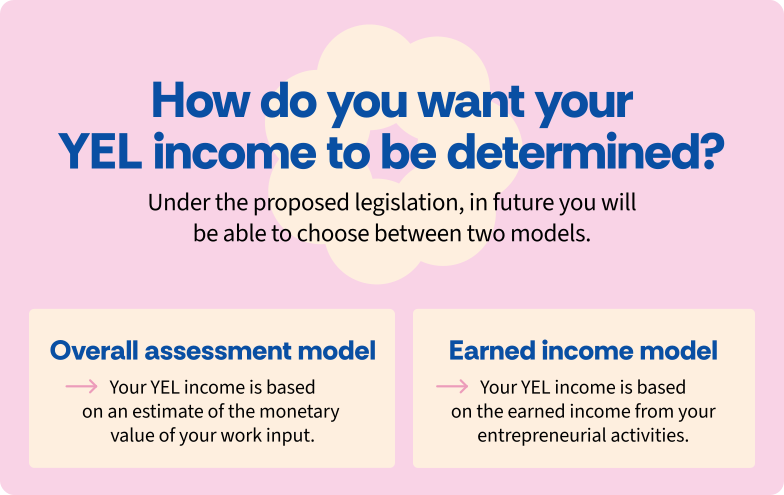
Infographic showing two alternative ways to determine YEL income: the overall assessment model and the earned income model.

What happens now?

The government proposal on the reform of the Self-Employed Persons’ Pensions Act (YEL) came before Parliament on 8 October 2026. For the time being, you are not required to take any action. You can simply wait and see how the reform progresses. We will follow the legislative process. We will help you and advise you in making the required choices well before the act enters into force.

Frequently asked questions about the YEL reform

According to the legislative proposal, you would be able to request information from us as of 1 January 2028 in order to compare options and choose a YEL income basis. The choice and new YEL income would take effect on 1 April 2028.

When it becomes possible to compare options, we will let you know what information we will use in the calculations and how the options will affect your situation.

The choice would be in force for three years at a time. After that, you could reassess your situation and choose which model your YEL income would be based on. 

The model you choose will be valid for three years at a time. When the period ends, you could choose whichever model suits your situation best.

If a significant change were to take place in your work, you could switch from the earned income model to the overall assessment model. Switching models in the other direction would not be possible.

As a new entrepreneur, you would first estimate the earned income from your entrepreneurial activities yourself. We would use this estimate until we had access to the actual earnings information from the Incomes Register or taxation.

The YEL contribution discount for new entrepreneurs would be eliminated. If you were granted the discount before the reform enters into account, you could, however, keep it if you wish. 

If you keep the discount

  • your YEL income would be determined based on the overall assessment model and you couldn’t choose the earned income model,
  • an annual earned income review would be conducted on your YEL income,
  • you would not be able to use the flexibility option for YEL contributions. 

We will help you compare the alternatives so that you can choose the most suitable option for your situation.

The intention is to increase the downward flexibility option of your YEL income through the reform. The flexibility option would rise from 20 per cent to 25 per cent. The change would ease the adjustment of YEL contributions in line with the financial status of the entrepreneurial activities. 

According to the legislative proposal, the earnings-related pension insurance companies’ task is to review the earnings information in both models annually.

  • In the overall assessment model, YEL income must be at least 50 per cent of the self-employed person’s earned income. 
  • In the earned income model, YEL income must correspond to the self-employed person’s earned income. The YEL income must, however, be at least the size of the lower limit for the YEL obligation 

The reviewed YEL income would enter into force from the start of the year following the review.

Read more about the YEL reform

Three great reasons to take out YEL insurance with Varma

Easy-to-use online service

You can conveniently manage your YEL insurance matters in Varma Online Service when it suits you best.

Log in to Varma Online Service

Friendly and professional service

Our experts support you in navigating all the twists and turns of your life as a self-employed professional. Our friendly customer service is easy to reach by phone, through chat, or in Varma Online Service.

See Varma's contact information

Flexible payment arrangements

If you ever find yourself in need of flexible payment arrangements we will find a solution for your situation together. Varma has its own knowledgeable collection advisors, so please don't hesitate to contact us!